Balochi embroidery and the Balochi dress: a simple guide
Balochi embroidery is the dense, colourful hand stitching of the Baloch people. It covers the chest, sleeves and long front pocket of a woman's traditional dress, and it is one of the clearest signs that a garment is Baloch. This guide explains what it is, how to spot real hand work, and how to look after it.
What is Balochi embroidery?
The Baloch are a people whose homeland, Balochistan, stretches across southeastern Iran, western Pakistan and the far southwest of Afghanistan. The region was formally divided in the late 1800s, and today it lies within these three countries. Their language is Balochi, and Baloch families also live in the Gulf states and Oman.
In Balochi, embroidery is called doch, and a woman who embroiders for a living is known as a dochgir. So a search for Balochi doch is really a search for this craft. Hand embroidery is traditionally women's work. Skills pass from mother to daughter, girls often start learning basic stitches at about six or seven, and many women spend years stitching pieces for their daughters' dowries.
You will see the name spelt several ways: Balochi, Baluchi, Balouchi and Baluch. Baloch is the usual name for the people, and Balochi describes their language and culture.
Where the embroidery sits and how it looks
The traditional outfit is a loose dress called a pashk, worn with shalwar trousers and a large shawl. The embroidery is stitched as separate panels, then sewn on. Panel names change from area to area, but a typical outfit has:
- a large panel covering the chest (jig)
- a long panel down the front of the skirt that doubles as a pocket (often called pandol or pado)
- a panel on each sleeve cuff (banzari), in one Iranian account about 25 cm by 45 cm
- bands of embroidery on the trouser cuffs
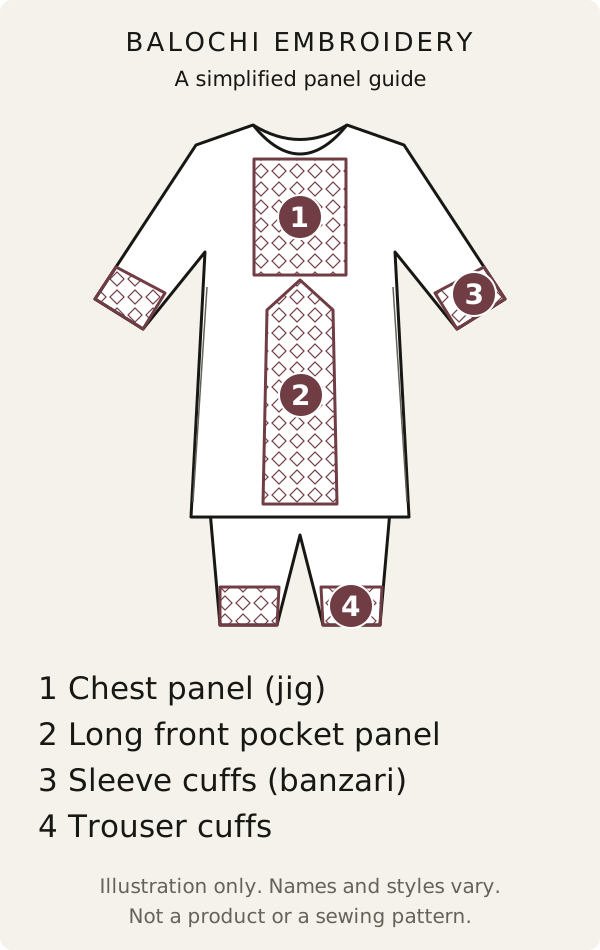
The front pocket is the main feature that marks a dress as Baloch, and it has long held everyday things such as thread and small change. A pashk is often passed from mother to daughter, and when the fabric wears out, the embroidered panels can be cut off and sewn onto a new dress. Men's caps and fitted vests are embroidered too.
The designs are geometric, repeating and symmetrical, often based on stylised flowers and leaves, and the stitching usually covers the base fabric completely. In Iran, traditional colours lean towards deep reds, orange and plum, and in Pakistan bright pink and parrot green are popular. Common stitches include satin, back, braid, running and buttonhole stitches. Small round mirrors, called shisha, appear in some areas and pieces, while others use thread alone or add sequins.
How to tell hand embroidery from machine embroidery
Machine embroidered panels in the Balochi style are now common, so it helps to know what to look for. No single sign is proof, and some machine work is very hard to pick, but together these clues help:
- Compare the repeats. In hand work, the same motif varies a little from one repeat to the next. Machine motifs tend to be identical in stitch size, position and colour.
- Look for perfect lines. Machine work can look as if every motif was lined up with a ruler.
- Check the front for loose threads carried between motifs. Hand embroiderers usually keep these on the back.
- Turn it over. A stiff backing fabric stitched directly behind the embroidery, or a second thread colour that shows only on the back, can point to a machine.
- Ask the seller how and where the piece was made.
Caring for embroidered pieces
This is general advice only. Always follow the care label on your garment first, and for MK Balure pieces see our care guide.
- Keep cleaning gentle. Many embroidered pieces are best dry cleaned. Air the piece and spot clean small marks with cold water. If a piece can be washed, a short hand wash in cool water with a mild detergent is the gentlest option. Test a hidden spot first in case colours run.
- Dry it flat in the shade. Direct sun fades colours over time.
- Iron from the back. Lay the embroidery face down on a folded towel and press lightly on the reverse. Use a pressing cloth if you need to press the front, and keep the iron off mirrors and sequins.
- Store it flat, or loosely folded with soft padding in the folds, in a breathable cotton bag rather than plastic.
- For old or very special pieces, ask a textile conservator before washing.
Balochi embroidery at MK Balure
MK Balure is an Australian brand sharing handmade Balochi embroidered clothing and accessories. If this guide has you curious, have a look:
Balochi embroidery FAQs
What does doch mean?
Doch is the Balochi word for embroidery. A woman who embroiders professionally is called a dochgir.
Is Baluchi embroidery the same as Balochi embroidery?
Yes. Balochi, Baluchi and Balouchi are different English spellings of the same name.
How long does Balochi embroidery take?
It depends on the size and detail of the piece. A skilled professional may finish a full dress in about a month, and finer work can take several months.
Does all Balochi embroidery have mirrors?
No. Mirror work is used in some areas and pieces. Many others are stitched with thread alone or finished with sequins.
When is Baloch Culture Day?
Baloch Culture Day is marked on 2 March each year, especially in Pakistan's Balochistan province. People wear traditional dress, and embroidery is often shown at stalls.